
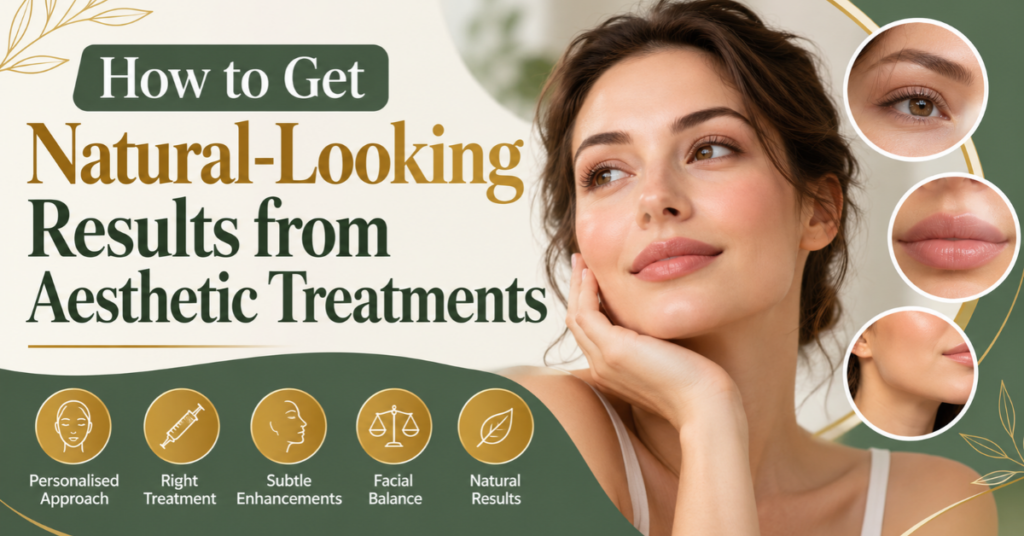
Natural-looking aesthetic treatments are about enhancing your appearance without losing the features that make you look like you. The most natural results usually come from choosing the right treatment for your individual concern, using an appropriate amount, considering facial balance and setting realistic expectations.
At The Beauty Blessings, we take a personalised approach to aesthetic treatment. Rather than following a one-size-fits-all treatment plan, we consider your facial features, skin, concerns and desired outcome before discussing suitable options.
The aim is not to change everything. It is to make thoughtful, proportionate improvements while keeping your natural appearance at the centre of the treatment plan.
What Does a Natural-Looking Aesthetic Treatment Mean?
A natural-looking aesthetic treatment does not necessarily mean that no change is visible.
Instead, it generally means that the result complements your existing features without appearing excessive, disproportionate or out of place. Your facial proportions, individual characteristics and appropriate facial expression remain an important part of the overall result.
For some people, this might mean softening the appearance of expression lines. For others, it could involve restoring subtle facial volume, improving lip definition or focusing on skin quality rather than adding volume.
The key question is not simply:
“Which treatment should I have?”
It is:
“What would I like to improve, and what do I want to keep looking natural?”
That distinction can make a significant difference to your treatment plan.
7 Ways to Achieve Natural-Looking Aesthetic Results
1. Start With a Personalised Consultation
Natural-looking results should start with a proper consultation rather than a treatment menu.
During your consultation, your practitioner should listen to what you would like to improve, understand your expectations, and consider your facial structure and overall appearance. Previous treatments, relevant medical information, skin condition and individual circumstances may also be discussed where appropriate.
A consultation can help determine whether treatment is suitable, which treatment may be relevant and how much change is realistically achievable.
Sometimes the most appropriate plan is one treatment. Sometimes it may involve a combination of treatments. In other cases, a practitioner may recommend delaying treatment or not treating an area at all.
A personalised assessment allows the treatment plan to be based on your features and goals rather than a trend or standard formula.
2. Choose the Treatment That Matches Your Concern
Not every cosmetic concern needs the same treatment.
For example, someone concerned primarily about expression lines may discuss anti-wrinkle treatment, while someone concerned about volume loss or facial contour may be assessed for dermal filler.
Another person may want to improve hydration, texture or the general appearance of their skin without adding facial volume.
A treatment plan should therefore begin with the concern itself.
| Concern | Treatment category that may be discussed | Primary focus |
| Expression lines | Anti-wrinkle treatment | Softening selected lines while maintaining an appropriate appearance |
| Loss of facial volume | Dermal fillers | Restoring or supporting facial balance |
| Lip shape or definition | Lip augmentation | Enhancing proportion and definition |
| Cheek definition | Cheek contouring | Supporting facial structure and balance |
| Chin or profile concerns | Chin filler | Considering chin-to-face proportions |
| Skin hydration or quality | Skin-focused treatments | Improving the appearance and condition of the skin |
This is why choosing a treatment simply because it is popular may not produce the result you are looking for.
3. Choose Subtle Enhancements Over Dramatic Changes
More treatment does not automatically mean a better result.
When the goal is a natural-looking appearance, a conservative approach may be more appropriate than trying to correct several concerns at once.
Small changes can sometimes make a noticeable difference to how refreshed or balanced the face appears, particularly when treatment is carefully planned around existing facial features.
Natural-looking aesthetic treatment is not about removing every wrinkle, creating maximum volume or trying to achieve somebody else’s appearance.
Instead, it is about asking whether the proposed change is appropriate for your face, your concern and your expectations.
4. Consider Facial Balance, Not Just Individual Features
Your face is a combination of features that work together.
The appearance of the lips, cheeks, chin and jawline can influence how the rest of the face is perceived. This is why looking at one feature in isolation may not always provide the clearest picture.
For example, if someone is concerned about the appearance of their chin or profile, the assessment may also need to consider how the chin relates to the lips, cheeks and lower face.
Similarly, adding volume to one area may affect the overall appearance of another area.
A whole-face approach can therefore help keep treatment focused on balance, proportion and harmony, rather than simply increasing volume.
5. Don’t Assume More Volume Is the Answer
One of the most important principles of natural-looking filler is understanding that not every concern requires more volume.
For some people, adding volume may be appropriate. For others, the main concern may be skin quality, facial definition or expression lines.
The correct approach depends on the individual.
With dermal fillers, factors such as facial anatomy, treatment area, product selection, placement and the desired outcome all matter. The appropriate amount can also vary significantly from one person to another.
At The Beauty Blessings, our approach is to assess what the client wants to achieve before recommending a treatment plan, rather than treating every concern with the same technique.
Can Dermal Fillers Look Natural?
Yes, dermal fillers can look natural when they are appropriately selected and carefully planned for the individual.
Natural-looking filler is not simply about using less product. It is about choosing the appropriate treatment area, considering facial anatomy and proportions, understanding the desired outcome and avoiding unnecessary volume.
Different areas of the face require different approaches.
Lips, cheeks, chin and jawline have different anatomical structures and aesthetic considerations, so there is no universal amount or technique that will produce the same result for everyone.
The objective should be to create an improvement that works with your existing facial features rather than overpowering them.
How Can You Avoid Looking Overfilled After Dermal Fillers?
A clear consultation is one of the most important steps.
Tell your practitioner how much change you want and, importantly, what you do not want to change. If you prefer a subtle result, explain this clearly.
It can also be helpful to avoid making treatment decisions based only on social media trends, celebrity appearances or the idea that more product will produce a better result.
A personalised and measured treatment plan can help maintain facial proportions and reduce the risk of unnecessary over-treatment.
Where clinically appropriate, The Beauty Blessings also offers filler-dissolving assessment and treatment for certain hyaluronic-acid filler concerns, including situations involving excess filler.
Any corrective treatment should be considered following an appropriate assessment.
Can Anti-Wrinkle Treatments Look Natural?
Yes, anti-wrinkle treatments can be used to soften selected expression lines while aiming to preserve appropriate facial movement.
The face contains multiple muscles that contribute to different expressions, and muscle activity varies between individuals.
That is why anti-wrinkle treatment should be tailored to the individual rather than applied using exactly the same approach to everyone.
A natural-looking outcome does not necessarily mean removing every expression line.
For many people, the goal is simply to soften the appearance of certain lines while retaining a facial appearance that still feels like their own.
The emphasis should be on balance and appropriate treatment, not making the face appear completely expressionless.
When Skin Quality Matters More Than Facial Volume
Sometimes the concern is not a lack of volume at all.
You may be more interested in skin that appears dry, tired, dull or less hydrated. In these situations, a skin-focused treatment may be more relevant than simply adding volume.
Skin-focused aesthetic treatments can be considered when the primary goal is to improve the appearance and quality of the skin rather than substantially changing facial structure.
This creates an important distinction:
Volume-focused treatments and skin-focused treatments address different concerns.
A consultation can help determine which category is more relevant to your goals.
At The Beauty Blessings, skin-focused treatment options can be discussed alongside injectable treatments so that the proposed treatment plan is based on the actual concern rather than simply selecting the most popular procedure.
Choose a Treatment That Fits Your Features
There is no single aesthetic treatment that is right for everyone.
Two people of the same age may have completely different concerns, facial structures and expectations.
One person may be mainly concerned about fine lines. Another may be interested in facial contour. Someone else may want to improve the appearance of their lips, while another person may be more concerned about skin quality.
This is why treatments should be selected according to individual needs rather than social media trends or what happens to be popular at the time.
Your consultation should cover what you would like to improve, what you are already happy with and what level of change you are comfortable with.
The treatment plan should then reflect those priorities.
What Should You Ask Before an Aesthetic Treatment?
A good consultation should give you an opportunity to make an informed decision.
Before agreeing to treatment, consider asking:
1. Why have you recommended this treatment for me?
Understanding the reason behind the recommendation helps you decide whether the treatment addresses your actual concern.
2. What result should I realistically expect?
Results vary between individuals. A responsible practitioner should explain what is realistic rather than promise a specific outcome.
3. What product or treatment will be used?
You should understand what treatment is being proposed and what it is intended to achieve.
4. How much change should I expect?
This is particularly important when your goal is subtle enhancement.
5. What are the possible risks and side effects?
No cosmetic treatment is completely risk-free. Make sure you understand the relevant risks before proceeding.
6. What aftercare will I need?
Your practitioner should explain appropriate aftercare and what to do if you have concerns following treatment.
7. Do I actually need treatment?
A consultation should help you make an informed decision, not make you feel that you need to have more procedures.
Why Practitioner Choice Matters for Natural-Looking Results?
Technique matters, but knowing when not to treat matters too.
A suitable practitioner should be able to assess facial structure, discuss realistic outcomes and explain the potential benefits and risks of a treatment.
They should also listen carefully to your goals.
The cheapest treatment is not necessarily the most appropriate, and a longer treatment list does not automatically mean a better treatment plan.
When choosing an aesthetics practitioner, look at their relevant training, experience, treatment-specific competence, consultation process and approach to patient care.
You should also feel comfortable asking questions and taking time to make your decision.
The Beauty Blessings Approach
At The Beauty Blessings, natural-looking aesthetic results begin with understanding the individual rather than applying a standard treatment formula.
Our approach focuses on:
1. Personalised consultation: Understanding your concerns, goals and expectations before recommending treatment.
2. Facial balance: Considering individual features in relation to the face as a whole.
3. Appropriate treatment selection: Choosing treatments according to the concern being addressed.
4. Subtle enhancement: Focusing on proportionate changes rather than unnecessary volume or dramatic transformation.
5. Individual treatment planning: Recognising that different people may need different approaches, amounts and treatment areas.
6. Ongoing assessment: Reviewing results appropriately and discussing further treatment only where it is suitable.
The goal is not to create a completely different appearance.
It is to help you feel more comfortable with the features you already have while making carefully considered improvements where appropriate.
Natural-Looking Results Are About Refinement, Not Perfection
The goal of aesthetic treatment does not have to be perfection.
For many people, the desired outcome is simply to look more refreshed, balanced or defined while still looking recognisably like themselves.
A personalised consultation, suitable treatment choice, conservative planning, appropriate technique and realistic expectations can all contribute to a natural-looking result.
The most important question is not how much treatment you can have.
It is how much treatment is appropriate for you.
At The Beauty Blessings, we keep individual features, facial balance and personal goals at the centre of treatment planning so that aesthetic enhancement remains personal and proportionate.
Book a Personalised Aesthetic Consultation
Natural-looking aesthetic treatment starts with understanding what you want to improve and what you want to keep unchanged.
At The Beauty Blessings, consultations are designed to help you understand suitable treatment options, expected outcomes and the approach that may be appropriate for your individual features and goals.
Discuss your aesthetic goals with The Beauty Blessings and explore a personalised treatment plan.
Frequently Asked Questions
1. How can I make aesthetic treatments look more natural?
Choose an appropriately trained practitioner, begin with a personalised consultation, and clearly explain the result you want. Treatment should be selected according to your facial features and concerns, with the amount and placement tailored to you rather than based on a standard formula.
2. What is a natural-looking aesthetic treatment?
A natural-looking aesthetic treatment aims to improve or refresh a particular feature without unnecessarily changing your overall appearance. Facial proportions, individuality and appropriate expression should remain part of the treatment plan.
3. Can dermal fillers look natural?
Yes. Dermal fillers can look natural when the treatment, product, amount and placement are appropriate for the individual. The result depends on factors such as facial anatomy, treatment area, practitioner technique and the desired outcome.
4. How can I avoid looking overfilled after fillers?
Discuss your preferred level of enhancement during consultation and explain that you want a proportionate result. Avoid choosing treatment based only on trends or the desire for maximum volume. A personalised, measured approach can help preserve facial balance.
5. Can anti-wrinkle treatments look natural?
Yes. Anti-wrinkle treatments can be used to soften selected expression lines while aiming to preserve appropriate facial movement. The treatment should be tailored to your individual muscle activity, facial anatomy and desired result.
6. Is more filler always better for a natural result?
No. The appropriate amount of filler varies between people and treatment areas. More product may create more volume, but more volume does not automatically produce a more balanced or natural-looking result.
7. How do I choose the right aesthetic treatment for me?
Start with a professional consultation. Explain what you would like to improve, what you want to keep natural and how much change you are comfortable with. Your practitioner can then discuss suitable treatment options based on your individual features and goals.
8. What if I want better skin quality rather than more facial volume?
Tell your practitioner that improving skin quality is your main concern. Depending on your individual needs, skin-focused treatments may be discussed instead of treatments designed primarily to add volume.
9. What should I ask an aesthetic practitioner before treatment?
Ask who will perform the treatment, what relevant training and experience they have, why the treatment has been recommended, what product will be used, what results are realistic, what risks may occur and what aftercare will be required.
10. Are natural-looking aesthetic treatments risk-free?
No cosmetic treatment is completely risk-free. Risks vary depending on the treatment, product and individual circumstances. You should understand the relevant risks, benefits, alternatives and aftercare before deciding whether to proceed.
11. What happens if I am unhappy with my filler result?
Speak to an appropriately trained practitioner for an assessment before having further treatment. The appropriate next step depends on the filler used, treatment area, timing and reason for concern. In some cases involving hyaluronic-acid filler, dissolving treatment may be considered where clinically appropriate.
12. How long should I wait before judging an aesthetic treatment result?
The appropriate review period depends on the treatment. Temporary swelling, redness or bruising may affect the initial appearance of some procedures. Your practitioner should explain when the result should be reviewed and when you should seek advice about any concerns.