
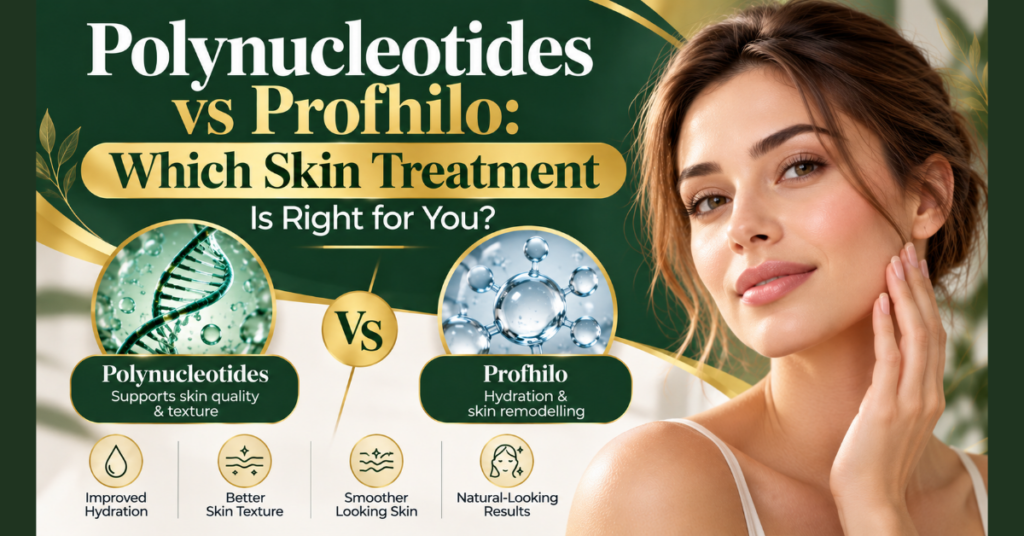
If you are exploring injectable skin treatments to improve hydration, texture or the appearance of fine lines, you may have come across polynucleotides and Profhilo. Both are used in aesthetic practice to improve skin quality, but they contain different ingredients and are not interchangeable treatments.
So, which is better: polynucleotides or Profhilo?
The answer depends on your skin concerns, treatment goals, medical history and suitability. Profhilo is a hyaluronic acid-based injectable treatment commonly chosen to improve hydration and overall skin quality. Polynucleotide treatments are designed to support skin quality and regenerative processes, although the evidence and approved uses vary by product.
At The Beauty Blessings, we offer Profhilo and polynucleotide treatments as part of our skin-focused aesthetic services. An individual consultation can help you understand the differences, discuss realistic outcomes, and decide whether either treatment is appropriate for you.
Quick Answer: Polynucleotides vs Profhilo
Profhilo may be considered when hydration, skin elasticity and an overall improvement in skin quality are the main concerns. Polynucleotides may be considered for selected skin-quality concerns, including texture and the delicate under-eye area, depending on the product and individual suitability.
Neither treatment is universally better. Both are injectable procedures, and the most appropriate option should be determined by a qualified practitioner following an assessment.
| Comparison | Polynucleotides | Profhilo |
| Main ingredient | Polynucleotide compounds; formulation varies by product | Stabilised hyaluronic acid |
| Main treatment focus | Supporting skin quality and repair-related processes | Hydration and skin remodelling |
| Commonly discussed concerns | Skin texture, selected under-eye concerns and overall skin quality | Dehydrated skin, reduced elasticity and uneven skin quality |
| Treatment approach | Product- and area-specific injection technique | Product-specific injection technique |
| Results | Gradual and variable; depend on product and individual response | Gradual and variable; depend on product and individual response |
| Best choice | Determined by skin assessment and product suitability | Determined by skin assessment and product suitability |
These are broad distinctions. Specific products, injection techniques, treatment areas and evidence may differ, so a practitioner should explain the product being considered rather than treating all polynucleotide products as identical.
What Are Polynucleotides?
Polynucleotides are compounds made from chains of nucleotides, the building blocks of DNA and RNA. Certain injectable aesthetic products containing polynucleotides are used to support skin-quality improvement.
Depending on the specific product, practitioner and treatment area, polynucleotide injections may be considered for concerns such as skin texture, the appearance of fine lines or selected under-eye skin-quality issues.
Some products are derived from purified fish DNA. However, the source and formulation are product-specific, so it is important to check the exact product being used, particularly if you have allergies or other relevant medical concerns.
What skin concerns may polynucleotides address?
A practitioner may discuss polynucleotides if your concerns include:
- The appearance of fine lines or uneven skin texture.
- Selected skin-quality concerns around the eyes.
- Skin that appears tired or less smooth.
- A desire to explore skin-focused injectable treatments rather than treatments intended primarily to add facial volume.
Polynucleotides are not a guaranteed treatment for dark circles, under-eye hollows, pigmentation, deep wrinkles or loose skin. The cause of the concern matters, and another treatment—or no injectable treatment—may be more appropriate.
How do polynucleotide treatments work?
Polynucleotide products are intended to support processes associated with skin repair and tissue quality. Research into their aesthetic use is developing, and the strength of evidence varies by product, indication and treatment protocol.
It is important to distinguish proposed biological mechanisms from proven cosmetic outcomes. A practitioner should explain what is known about the particular product, what improvements may be realistic and where the evidence remains limited.
What Is Profhilo?
Profhilo is an injectable treatment containing stabilised hyaluronic acid. Hyaluronic acid is a substance naturally found in the body that helps retain moisture.
Profhilo is commonly used as a skin-remodelling treatment to improve hydration and the appearance of skin quality. It is not intended to work like a conventional dermal filler that adds targeted volume to create or reshape facial contours.
What skin concerns may Profhilo address?
Profhilo may be considered for people concerned about:
- Dehydrated or dry-looking skin.
- Reduced skin elasticity.
- Uneven or rough skin texture.
- Fine lines associated with changes in skin quality.
- Skin that appears less radiant or supple.
The suitability of Profhilo depends on the treatment area, the individual’s skin and the product’s instructions. It will not necessarily correct significant skin laxity, deep wrinkles or facial volume loss.
How does Profhilo work?
Profhilo delivers hyaluronic acid into selected areas of the skin. Its intended effects include improving hydration and supporting skin remodelling.
Some product information and clinical studies discuss changes in collagen and elastin-related markers. However, outcomes are not guaranteed, and results should not be described as a predictable lifting effect or a replacement for surgery.
A consultation should cover the expected benefits, limitations, potential adverse effects and the recommended treatment protocol for the specific product.
Polynucleotides vs Profhilo: What Is the Difference?
The key difference is their formulation and treatment focus.
Profhilo is a hyaluronic acid-based injectable treatment associated primarily with hydration and skin remodelling. Polynucleotide products are used with the aim of supporting skin quality and repair-related processes.
Neither treatment should be described as a universal skin-tightening solution, and neither is automatically safer or more effective for every person.
1. Ingredients
Profhilo contains stabilised hyaluronic acid.
Polynucleotide treatments contain polynucleotide compounds, with the formulation and source varying between products.
If you have an allergy, medical condition, previous reaction to an injectable or concern about product ingredients, discuss this before treatment.
2. Skin concerns
Profhilo is commonly considered when skin hydration, elasticity and general skin quality are the priorities.
Polynucleotides may be considered for selected skin-quality concerns, including certain texture or under-eye concerns.
These are not strict categories. The right option depends on the actual cause of your concern and the evidence for the specific product and treatment area.
3. Results and timing
Both treatments may produce gradual changes rather than an immediate, dramatic transformation.
The timeline and extent of improvement vary according to the product, treatment protocol, skin condition and individual response. A practitioner should provide realistic expectations based on the proposed treatment.
4. Treatment sessions
The number and spacing of sessions depend on the specific product and its instructions, as well as the practitioner’s assessment.
Some protocols involve an initial course followed by maintenance. Do not assume that every polynucleotide product or every Profhilo treatment follows the same schedule.
5. Risks and suitability
Both are injectable treatments and may cause temporary effects such as redness, swelling, tenderness or bruising. More serious complications, including infection or vascular complications, are possible with injectable procedures.
A practitioner should assess your medical history, explain the relevant risks and discuss what to do if you experience unexpected symptoms after treatment.
Polynucleotides or Profhilo: Which May Suit Your Skin Concern?
The following examples can help you understand what might be discussed at a consultation. They are not a recommendation to select or book a treatment without an assessment.
1. If your main concern is dry or dehydrated-looking skin
Profhilo may be worth discussing because it contains hyaluronic acid and is used to improve skin hydration and quality.
However, dryness can also be associated with skincare products, environmental factors or skin conditions. An injectable treatment is not always necessary.
2. If your main concern is skin texture
Polynucleotides may be discussed for selected texture-related concerns. Profhilo may also be considered when texture changes are associated with dehydration or reduced skin quality.
The cause and severity of the texture concern should guide the treatment discussion.
3. If you are concerned about the under-eye area
The under-eye area is delicate and can be affected by several different factors, including pigmentation, hollowness, swelling, skin texture and anatomy.
Polynucleotides may be considered for selected under-eye skin-quality concerns. However, they are not a guaranteed solution for dark circles or hollowness, and treatment in this area requires particular care.
4. If you are concerned about mild changes in skin elasticity
Profhilo may be discussed as a skin-quality treatment. The extent of any improvement in firmness or elasticity is variable.
If your concern is significant skin laxity, a practitioner may explain that an injectable skin booster is unlikely to provide the degree of lifting you are looking for.
5. If you want a more comprehensive skin treatment plan
A consultation may identify that neither treatment is the best first option. Skincare, sun protection, treatment of an underlying skin condition or another aesthetic approach may be more appropriate.
At The Beauty Blessings, treatment planning starts with your individual concerns and suitability rather than choosing a popular injectable in advance.
6. Can You Have Polynucleotides and Profhilo Together?
Some practitioners may consider using different skin treatments within an individual treatment plan. However, combining polynucleotides and Profhilo is not automatically necessary, and there is no universal schedule that is appropriate for everyone.
Before considering a combination, a practitioner should assess:
- Your skin concerns and desired outcome.
- The exact products being proposed.
- Your medical history and any previous reactions.
- The proposed treatment areas and injection sites.
- The evidence, product instructions and potential risks of combining treatments.
- Appropriate timing, recovery and aftercare.
Having more than one injectable treatment does not guarantee a better result. The practitioner should explain why a combination is being considered and whether a simpler approach could meet your goals.
How Long Do Polynucleotide and Profhilo Results Last?
Results vary between individuals and products. Factors that may influence outcomes include the treatment area, skin condition, age, lifestyle, treatment protocol and individual response.
Both treatments may involve an initial course and, where appropriate, later maintenance. The number of sessions and maintenance interval should follow the product guidance and an individual assessment.
Neither treatment stops the natural ageing process, and neither can guarantee permanent improvements.
During your consultation, ask how long results may reasonably last for your proposed treatment, when changes are expected to become noticeable and whether maintenance may be recommended.
What Are the Risks and Aftercare Considerations?
Polynucleotides and Profhilo involve injections, so they should be treated as medical aesthetic procedures rather than routine facials.
Possible short-term effects include:
- Redness or swelling around injection sites.
- Tenderness, discomfort or bruising.
- Temporary small bumps or unevenness.
- Sensitivity in the treated area.
The risks depend on the product, injection site, technique and individual circumstances. Infection, allergic reactions and vascular complications are less common but potentially serious.
Before treatment, tell your practitioner about relevant allergies, medical conditions, medicines, previous injectable treatments and any history of adverse reactions.
Follow the specific aftercare instructions provided by your practitioner. Seek prompt medical advice if you develop severe or worsening pain, unusual skin colour changes, rapidly increasing swelling, signs of infection or any unexpected symptoms that concern you. Sudden visual disturbance after facial injections requires emergency medical attention.
Polynucleotides and Profhilo at The Beauty Blessings
The Beauty Blessings offers Profhilo and polynucleotide treatments as part of its skin-focused aesthetic services.
Our approach is consultation-led. We discuss your concerns, assess suitability and explain the options, expected outcomes, limitations and potential risks before a treatment decision is made.
Our published treatment menu includes polynucleotide options for the eyes, face and neck, alongside Profhilo skin-boosting treatments. The exact product, treatment area, price and protocol should be confirmed with the clinic.
If you are considering treatment in Essex, you can review our treatment options and published prices, then arrange a consultation to discuss what may be appropriate for you.
Book a consultation with The Beauty Blessings to discuss your skin concerns and explore whether polynucleotides, Profhilo or another option may be suitable.
Ready to explore your options? Contact The Beauty Blessings to arrange a consultation and discuss your skin goals.
Frequently Asked Questions
1. Are polynucleotides better than Profhilo?
Neither treatment is universally better. Profhilo is commonly used to improve hydration and overall skin quality, while polynucleotides may be considered for selected skin-quality concerns. The most appropriate option depends on your skin, the product being used and professional assessment.
2. What is the main difference between polynucleotides and Profhilo?
Profhilo contains stabilised hyaluronic acid and is primarily associated with hydration and skin remodelling. Polynucleotide products contain polynucleotide compounds and are used with the aim of supporting skin quality and repair-related processes. They have different formulations and should not be treated as interchangeable.
3. Is Profhilo better for dry skin?
Profhilo may be considered when dehydration is a primary concern because it contains hyaluronic acid. However, dryness can have several causes, and a practitioner should assess your skin before recommending an injectable treatment.
4. Are polynucleotides suitable for the under-eye area?
Some polynucleotide products are used for selected under-eye skin-quality concerns. Suitability depends on the product, the cause of the concern and the individual’s anatomy. Polynucleotides are not a guaranteed treatment for dark circles, puffiness or hollowness.
5. Can you have polynucleotides and Profhilo together?
A practitioner may consider combining treatments in selected circumstances, but the combination is not suitable for everyone. The products, treatment areas, timing and risks should be assessed individually before proceeding.
6. How long do polynucleotide results last?
Results and their duration vary according to the product, treatment course, treatment area and individual response. Your practitioner should explain the expected timeline and whether maintenance may be appropriate.
7. How long do Profhilo results last?
The duration of results varies. It depends on factors such as your skin condition, treatment protocol and individual response. Ask your practitioner about the expected duration for the specific product and treatment plan being proposed.
8. Do polynucleotides or Profhilo treat deep wrinkles?
Neither treatment is a guaranteed solution for deep wrinkles. They are generally discussed in relation to skin quality, hydration and the appearance of fine lines. Deeper wrinkles may have other causes and require a different assessment or treatment approach.
9. How much do Profhilo and polynucleotide treatments cost at The Beauty Blessings?
The clinic’s published pricing lists Profhilo at £190 for one session and £380 for two sessions. Polynucleotide prices are listed by treatment area, including eyes, face or neck and full face. Check the current pricing page for the latest prices and confirm the exact product and treatment plan during consultation.
10. How do I choose between polynucleotides and Profhilo in Essex?
Start by identifying your main concern—such as dehydration, texture, fine lines or under-eye skin quality—and arrange an individual consultation. A practitioner can explain whether either treatment is appropriate, what results are realistic and what alternatives may be available.