
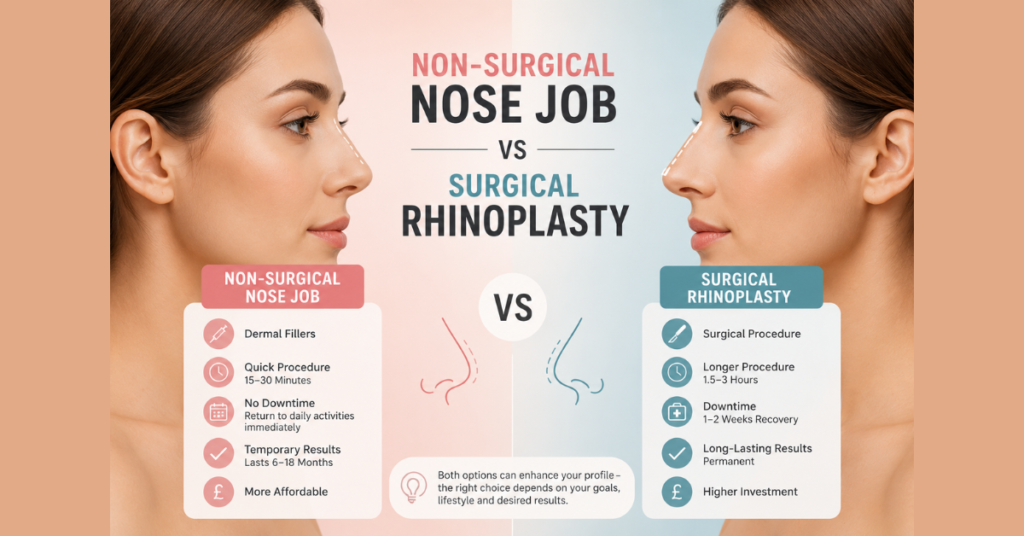
If you’re considering improving the appearance of your nose, you’ve probably come across two popular options: non-surgical rhinoplasty (also called a liquid nose job) and surgical rhinoplasty. While both procedures can enhance facial harmony, they differ significantly in how they are performed, the results they provide, recovery time, longevity, and cost.
Quick Answer
A non-surgical nose job uses hyaluronic acid dermal fillers to temporarily reshape the nose without surgery. It is ideal for correcting minor imperfections such as a dorsal hump, mild asymmetry, or a drooping nasal tip, with little to no downtime.
Surgical rhinoplasty, on the other hand, permanently reshapes the nose by modifying bone and cartilage. It is the preferred option for reducing nose size, correcting structural abnormalities, improving breathing problems, or achieving dramatic, long-lasting changes.
The best option depends on your goals, anatomy, budget, and whether you prefer a temporary or permanent solution.
Non-Surgical Rhinoplasty vs Surgical Rhinoplasty at a Glance
| Feature | Non-Surgical Nose Job | Surgical Rhinoplasty |
| Procedure | Injectable dermal fillers | Surgery |
| Anaesthesia | Topical numbing cream | General anaesthesia |
| Treatment Time | 15–30 minutes | 1–3 hours |
| Downtime | Minimal | 1–3 weeks |
| Results | Immediate | Several months as swelling settles |
| Duration | 9–18 months | Permanent |
| Reversible | Yes (hyaluronic acid fillers) | No |
| Can Reduce Nose Size | No | Yes |
| Can Improve Breathing | No | Yes |
| Best For | Minor cosmetic enhancement | Structural and permanent correction |
What Is a Non-Surgical Nose Job?
A non-surgical nose job, often called liquid rhinoplasty, is a minimally invasive cosmetic treatment that uses carefully placed hyaluronic acid dermal fillers to improve the shape and profile of the nose.
Rather than removing tissue, fillers add volume to strategic areas, creating the appearance of a straighter bridge, improved symmetry, or a more refined nasal tip.
Common concerns treated include:
- Small dorsal humps
- Mild asymmetry
- Flat nasal bridge
- Drooping nasal tip
- Minor contour irregularities
- Previous surgical imperfections
Treatment typically takes less than 30 minutes, and most patients return to normal activities the same day.
What Is Surgical Rhinoplasty?
Surgical rhinoplasty is a permanent cosmetic or functional procedure performed by reshaping the nasal bone, cartilage, or both.
Unlike fillers, surgery can completely alter the structure of the nose, making it possible to:
- Reduce nose size
- Narrow the bridge
- Refine the nasal tip
- Correct a crooked nose
- Repair injuries
- Improve breathing caused by structural abnormalities
- Correct a deviated septum (when combined with septoplasty)
Although recovery requires patience, surgical rhinoplasty provides long-term results that cannot be achieved with injectable treatments.
Non-Surgical Nose Job vs Surgical Rhinoplasty: Key Differences
Although both procedures aim to improve the appearance of the nose, they work in very different ways.
1. Procedure
A non-surgical rhinoplasty uses injectable fillers to reshape the nose without incisions. Surgical rhinoplasty permanently modifies bone and cartilage through carefully planned surgical techniques.
2. Results
Fillers provide subtle refinement and improved facial balance, while surgery allows comprehensive reshaping and structural correction.
3. Recovery
Most patients experience only mild swelling or bruising after fillers and can resume normal activities almost immediately.
Following surgery, swelling and bruising are expected, with visible healing occurring over several weeks and final results continuing to improve over several months.
4. Longevity
Dermal fillers gradually dissolve over time, typically lasting between 9 and 18 months depending on the product used and individual metabolism.
Surgical rhinoplasty offers permanent structural changes.
5. Flexibility
One major advantage of non-surgical rhinoplasty is reversibility. Hyaluronic acid fillers can often be dissolved if adjustments are needed, whereas surgical results are permanent.
Nose Filler vs Rhinoplasty: Which Delivers Better Results?
The answer depends entirely on what you hope to achieve.
Choose a non-surgical nose job if you want:
- A straighter nose profile
- Improved facial balance
- Better symmetry
- A lifted nasal tip
- Temporary enhancement
- Minimal downtime
Choose surgical rhinoplasty if you want:
- Permanent reshaping
- Nose reduction
- Structural correction
- Improved breathing
- Significant cosmetic transformation
- Long-lasting results
Neither treatment is universally better. The ideal choice depends on your anatomy, expectations, and desired outcome.
Who Is a Good Candidate for Non-Surgical Rhinoplasty?
You may be an ideal candidate if you:
- Are in good general health
- Want subtle cosmetic improvements
- Have realistic expectations
- Prefer to avoid surgery
- Want immediate results
- Are comfortable with maintenance treatments
Who Should Consider Surgical Rhinoplasty?
Surgical rhinoplasty may be more appropriate if you:
- Want permanent changes
- Need functional correction
- Wish to reduce nose size
- Have experienced nasal trauma
- Have significant structural concerns
- Want comprehensive reshaping
Pros and Cons of Non-Surgical Rhinoplasty
Advantages
- No surgery
- Immediate results
- Minimal downtime
- Reversible treatment
- Lower initial cost
- Quick procedure
- Natural-looking enhancement
Limitations
- Temporary results
- Maintenance appointments required
- Cannot reduce nose size
- Limited correction of structural issues
- Not suitable for every patient
Pros and Cons of Surgical Rhinoplasty
Advantages
- Permanent results
- Significant reshaping possible
- Functional improvements
- Corrects breathing issues
- One-time procedure for many patients
Limitations
- Higher upfront investment
- Surgical recovery
- Longer healing period
- Potential surgical risks
- Final results take months to fully develop
Frequently Asked Questions (FAQs)
1. What is the difference between a non-surgical nose job and surgical rhinoplasty?
A non-surgical nose job uses hyaluronic acid dermal fillers to temporarily reshape the nose without surgery. Surgical rhinoplasty permanently changes the bone and cartilage structure of the nose, allowing for more significant cosmetic and functional improvements.
2. Which is better: non-surgical rhinoplasty or surgery?
Neither option is universally better. A non-surgical nose job is ideal for minor cosmetic enhancements with minimal downtime, while surgical rhinoplasty is better for permanent reshaping, nose reduction, and correcting structural or breathing issues.
3. How long does non-surgical rhinoplasty last?
Most non-surgical rhinoplasty results last between 9 and 18 months, depending on the type of filler used, your metabolism, lifestyle, and the treated area. Maintenance treatments are usually recommended to preserve the results.
4. Is a non-surgical nose job permanent?
No. A non-surgical nose job is a temporary cosmetic procedure. As the body gradually breaks down the filler, the results fade over time and touch-up treatments are needed to maintain the desired appearance.
5. Can a non-surgical nose job make my nose smaller?
No. Dermal fillers cannot reduce the size of the nose because they add volume rather than remove it. However, strategically placed filler can create the appearance of a straighter, more balanced, or slimmer-looking nose.